
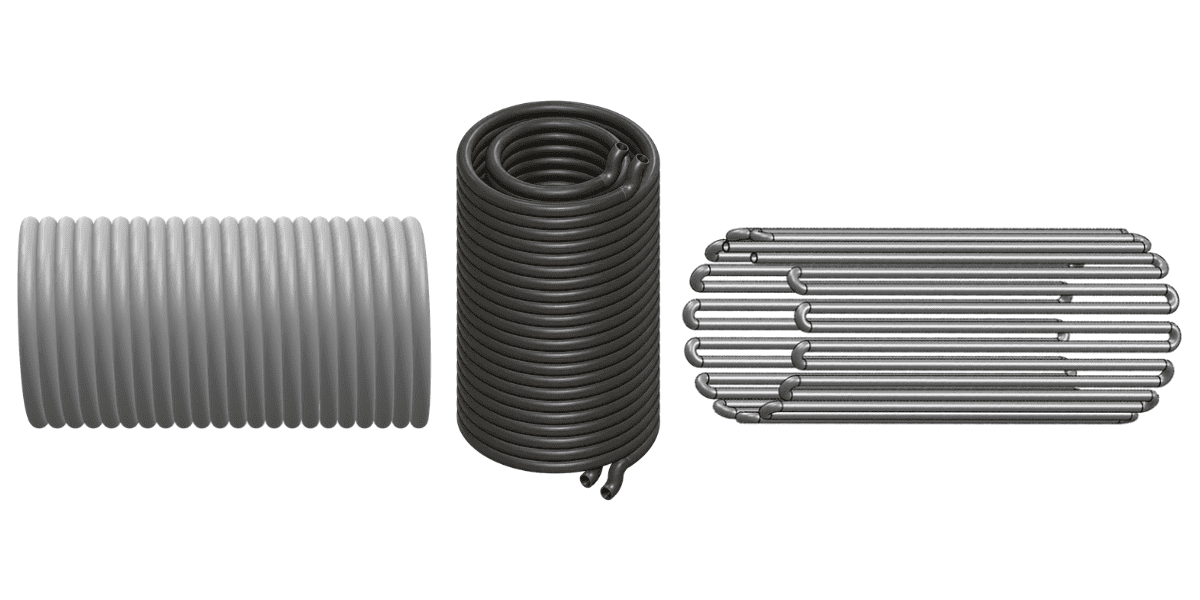
Cost and downtime both matter when a thermal fluid heater needs coil work. What drives both of them is how much of the coil has to come out.
That answer depends almost entirely on which coil design your heater uses: single helical, double helical, or serpentine. Each one changes how much disassembly a repair takes, how long you’re down, and what the final bill looks like.
Here’s what each coil design means for thermal fluid life, repair scope, downtime, and cost, so you can plan ahead instead of finding out the hard way.
Quick Answer: How the Three Coil Designs Compare
Here’s the short version, based on how each coil design is built.
| Coil Type | Typical Repair Scope | Downtime Risk | Best Fit |
| Single helical | Full coil must be replaced | Higher, since the full coil will need to be replaced | Compact systems where simplicity and lower upfront cost matter most |
| Double helical | Inner coil section can be replaced on its own | Moderate, as one coil will need to be replaced | Higher heat duty or efficiency needs, with more repair flexibility |
| Serpentine | Localized sections can be repaired in place | Lower, when damage is limited to one area | High capacity, uniform heat distribution, easier access |
The sections below explain why, and what to plan for with each one.
Thermal Fluid Replacement
Thermal fluid carries heat from the heater to your process. Over time, it breaks down from heat exposure, oxidation, contamination, and normal operating wear.
One thing that speeds this up more than people expect: film temperature, the temperature of the fluid right at the heated tube surface. Run it too hot, even for short periods, and you can cook the fluid faster than your maintenance schedule assumes.
Single Helical Coil Heaters
A single helical coil is one continuous wound coil. It’s a simple, compact design, which also makes it a predictable one: fluid flow and heat distribution follow one coherent path, so proper sizing, burner operation, and system controls do most of the work in protecting the fluid.
Don’t replace fluid on a fixed schedule just because that’s the default. Test it and watch system performance data instead. A fluid that’s holding up fine doesn’t need to go.
Double Helical Coil Heaters
A double helical design uses two coil sections, which adds heat-transfer surface area without growing the footprint much. That’s useful for higher heat duty or higher operating temperatures, but it also means fluid condition depends on more than the coil alone. Fluid velocity, burner setup, operating temperature, and fluid quality all still matter.
Serpentine Coil Heaters
A serpentine coil runs the fluid through multiple passes across a large surface area. That spreads heat out instead of concentrating it, which helps avoid the localized hot spots that drive up film temperature in the first place.
That design advantage only holds if the system is sized and operated correctly. No coil design overrides bad burner setup or poor flow control.
Whatever coil design you run, routine thermal fluid analysis is still the most reliable way to know when it’s time to replace the fluid. If yours is degrading faster than expected, these can help:
- Why Your Hot Oil Heater Is Burning Up Your Heating Fluid
- Why Investing in High Grade Heat Transfer Fluid is a MUST
Coil Repair and Replacement
The coil is the single most important part of a thermal fluid heater. It holds the circulating fluid while absorbing heat from the burner and combustion gases, so when it’s damaged, how you fix it depends heavily on how it was built.
Single Helical Coil Repairs
A single helical coil is one continuous assembly. If the damage is significant, there usually isn’t a way to isolate just the bad section. You’re often looking at replacing a large portion of the coil, or the whole thing.
That’s not a design flaw. It’s the tradeoff for a simpler, more compact heater. Just go in knowing what a major repair would actually involve, and keep an eye on replacement-part lead times before you need them.
Double Helical Coil Repairs
This is where the double helical design earns its keep. In Enerquip’s design, the inner coil, which carries the heaviest heat load and takes the most wear, can be removed and replaced on its own. You’re not required to tear into the whole assembly for damage that’s isolated to that section.
For maintenance teams, that’s the real difference from a single continuous coil: more targeted repairs are actually possible here.
Serpentine Coil Repairs
A serpentine coil is built in a serpentine fashion with space between the coil. When damage is limited to a specific area, that construction often lets you access and repair that section while leaving the rest of the assembly in place.
That said, an in-place repair isn’t automatically the right call. Coil condition, what caused the failure, how much service life is left, code requirements, and the manufacturer’s recommendations all factor into whether repairing makes sense or replacement is the better long-term move.
How Heater Design Affects Downtime
Downtime is often the most expensive part of a repair, even more than the parts themselves. If your heater feeds a critical process, every day it’s down ripples into production, schedules, and customer commitments.
Single Helical Coil Downtime
A major repair here usually means disassembling the heater, removing the coil, installing the new one, inspecting it, and bringing the system back online. That’s a longer path, and it leans heavily on how fast you can get a replacement coil and how much site access and labor the job needs.
Knowing your component lead times ahead of time, and planning for critical spare parts, is the best way to keep an unexpected repair from turning into an extended outage.
Double Helical Coil Downtime
Because the inner coil can often be serviced on its own, double helical heaters can offer more repair options than a single continuous coil. That doesn’t guarantee a shorter repair every time. It still comes down to the specific damage, parts on hand, site conditions, and what inspections are required.
Serpentine Coil Downtime
When a localized repair can be done in place, you skip a lot of the disassembly a full coil swap requires, which can shorten the job. But the actual outage still depends on how bad the damage is, what inspections are needed, and whether parts are on hand.
No matter which coil design you run, a solid spare parts strategy is one of the most effective ways to cut downtime risk.
How Coil Design Affects Repair Costs
The price of the damaged part is rarely the whole bill. A full repair estimate should account for:
- Replacement coils or tube sections
- Labor and contractor costs
- Disassembly and reassembly of the heater
- Insulation and refractory work
- Inspection and testing
- Replacement thermal fluid
- Freight, including any rush shipping
- Lost production during downtime
- Startup and recommissioning
A full coil replacement naturally costs more across the board than a repair limited to one section, simply because more of the list above comes into play. That’s why coil design belongs in your lifecycle cost math alongside the heater’s upfront price, fuel efficiency, expected service life, and what your process actually needs.
Which Thermal Fluid Heater Design Is Easier to Maintain?
There’s no single right answer here. It depends on what your facility needs most.
Single helical: makes sense when a compact footprint, simplicity, and lower upfront cost are your top priorities.
Double helical: gives you that same compact, helical design, plus more capacity, efficiency, or operating temperature, along with more flexibility when a repair is needed.
Serpentine: tends to win out for high-capacity applications where even heat distribution, easy access, and long-term serviceability matter most.
Weigh these alongside maintenance ease:
- Required heat duty
- Process temperature
- Operating schedule
- Available footprint
- Thermal efficiency goals
- Fluid pressure drop
- Upfront equipment cost
- Maintenance strategy
- Spare parts availability
- Expected equipment life
Should You Repair or Replace Your Thermal Fluid Heater?
When a heater develops a major problem, repair isn’t automatically the safe choice, and neither is replacement. Weigh the heater’s age, overall condition, repair history, efficiency, parts availability, coil condition, production needs, and how much service life it has left.
Just as important: figure out why the problem happened in the first place. Low fluid flow, improper burner operation, excessive temperatures, fluid degradation, fouling, or another system issue needs to be fixed along with the damaged part. Otherwise, whatever caused the damage the first time is still there, quietly working against whatever you repair or replace.
Frequently Asked Questions
Which thermal fluid heater coil design is easiest to repair?
Serpentine coils usually allow the most targeted repairs, since damage limited to one section can often be fixed without touching the rest of the coil. Double helical comes next, since the inner coil section can be replaced on its own. Single helical is the least flexible: major damage often means replacing a large portion of the coil or the whole assembly.
Can a damaged coil be repaired without replacing the whole thing?
Sometimes, and it depends heavily on the coil design and where the damage is. Serpentine and double helical designs make a partial repair more realistic. A single helical coil’s one-piece construction makes a partial fix harder to isolate.
How do I know if I should repair or replace my thermal fluid heater?
Look at the heater’s age, condition, repair history, efficiency, and remaining service life, along with whether replacement parts are still available. Just as important, figure out what caused the damage. If an underlying issue like fluid degradation, fouling, or burner problems caused the failure, it needs to be fixed too, or the same thing happens again.
How often should thermal fluid be replaced?
There’s no universal schedule. Routine fluid testing and system performance monitoring are a more reliable way to know when fluid needs to be replaced than a fixed calendar interval.
Not Sure Which Coil Design You’re Running, or What It Needs?
Whether you operate a single helical, double helical, or serpentine coil thermal fluid heater, Enerquip can look at your setup and help you figure out the right path forward.
We offer multiple thermal fluid heater configurations, so you have options based on heat duty, operating temperature, footprint, efficiency, maintenance priorities, and budget. If your heater needs repair, or you’re weighing repair against replacement, our engineering team can review your application and point you toward what actually fits your process.
Call Enerquip at (833) 516-6888 or contact us online to talk through your thermal fluid heater repair or replacement needs.