
Industrial heating equipment rarely fails at a convenient time. When a heater, heat exchanger, or related component goes down during production, a facility may be left waiting for technicians, replacement parts, or custom-fabricated equipment. Meanwhile, the cost of lost production keeps climbing.
Proactive maintenance can reduce that risk, but it requires time, planning, and labor. Reactive maintenance requires less work upfront, but a single unexpected failure can quickly erase those savings.
For most facilities, the best plant maintenance strategy is neither fully proactive nor fully reactive. Critical industrial heating equipment should receive planned attention, while inexpensive, noncritical components may reasonably be allowed to run until they need repair or replacement.
The right approach starts with one question: What happens if this equipment fails unexpectedly?
What Is Proactive Maintenance?
Proactive maintenance focuses on preventing equipment failures before they occur. Rather than waiting for a breakdown, maintenance teams inspect equipment, monitor its condition, and address developing problems before they interrupt production.
For thermal process equipment, proactive maintenance may include:
- Routine equipment inspections
- Cleaning heat transfer surfaces
- Monitoring equipment performance
- Checking controls and safety systems
- Inspecting burners, valves, piping, and related components
- Replacing worn parts
- Planning repairs before a failure occurs
- Maintaining service and inspection records
Maintenance requirements will vary by equipment type, application, operating conditions, and manufacturer recommendations. Facilities should use qualified personnel and follow the appropriate safety procedures when inspecting or servicing equipment.
Benefits of Proactive Maintenance
More Control Over Maintenance Costs
Repairs and equipment replacements are inevitable, but proactive maintenance gives facilities more time to plan and budget for them.
When a problem is found early, the facility may be able to secure parts, schedule labor, and complete the repair during a planned shutdown. This can reduce emergency service costs, overtime labor, expedited shipping, and rush fabrication.
Fewer Unexpected Failures
Routine inspections can help maintenance teams catch worn components, performance issues, and other problems before they become major failures.
Finding a problem does not always mean the equipment must be shut down immediately. It may give the team enough time to evaluate the issue, determine the best response, and choose when the work will be completed.
Reduced Unplanned Downtime
When problems are identified early, repairs can often be scheduled during a planned maintenance period or plant shutdown rather than forcing production to stop unexpectedly.
This is especially important for industrial heating equipment that supports a continuous process or has no installed backup.
Better Equipment Reliability
Maintenance records can help facility managers identify recurring problems, monitor equipment condition, and make more informed repair or replacement decisions.
These records can also reveal changes in performance, recurring failure patterns, and components that may need more frequent attention.
Challenges of Proactive Maintenance
Proactive maintenance requires more planning than a reactive approach.
Facilities may need to create inspection schedules, assign responsibilities, train employees, document maintenance work, and dedicate time to routine service.
There is also a risk of performing unnecessary work if every asset receives the same maintenance schedule. Servicing equipment more often than needed can waste labor and replacement parts without meaningfully improving reliability.
A strong proactive maintenance program prioritizes equipment based on risk. The most time and attention should go to assets that are critical to production, difficult to replace, or likely to create serious operational consequences if they fail.
What Is Reactive Maintenance?
Reactive maintenance is a strategy in which equipment is repaired or replaced after a failure occurs.
A facility continues operating equipment until something requires attention. The maintenance team then diagnoses and repairs the problem.
Reactive maintenance is also known as breakdown maintenance or run-to-failure maintenance.
This approach is not automatically poor maintenance. Run-to-failure can be a reasonable and intentional strategy for the right equipment. It becomes risky when it is used by default for assets that are critical to production.
Benefits of Reactive Maintenance
Lower Upfront Maintenance Requirements
A reactive approach typically involves fewer scheduled inspections and maintenance tasks. For inexpensive, noncritical equipment, the cost of routine maintenance may be greater than the cost of simply replacing the component when it fails.
Simple to Implement
Reactive maintenance requires less upfront planning. The equipment remains in service until it no longer performs as required, at which point the facility repairs or replaces it.
Full Use of a Component’s Service Life
Replacing parts on a set schedule can sometimes mean removing components that still have useful life remaining. A run-to-failure strategy avoids early replacement, provided the failure will not damage other equipment or create safety, environmental, quality, or production concerns.
Risks of Reactive Maintenance
The disadvantages become more significant when reactive maintenance is applied to critical equipment.
More Unexpected Equipment Failures
Without regular inspections, small problems may go unnoticed until equipment stops operating.
In some cases, a relatively minor issue can also contribute to damage elsewhere in the system, making the final repair larger and more expensive.
Increased Downtime
If critical industrial heating equipment fails, production may need to slow or stop while parts are located and repairs are completed.
Downtime may be extended when the failed component is custom-made, no longer available, or subject to a long manufacturing lead time.
Higher Emergency Repair Costs
Unexpected failures can lead to additional expenses, including:
- Overtime labor
- Emergency service calls
- Expedited freight
- Rush fabrication
- Temporary equipment
- Lost production
The repair itself may be only a small part of the total cost. Lost production, delayed orders, additional staffing needs, and missed customer commitments can have a much greater financial impact.
Greater Operational Disruption
A breakdown can affect production schedules, customer orders, staffing, and other planned work throughout the facility. Maintenance employees may also be pulled away from scheduled projects to respond to the emergency, creating delays elsewhere in the plant.
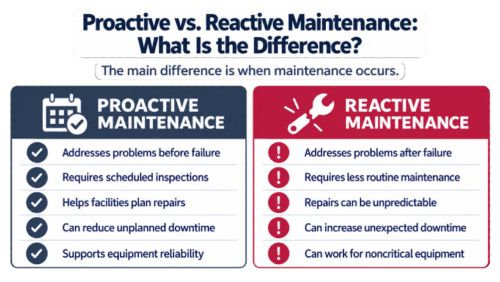
Proactive vs. Reactive Maintenance
How to Choose the Right Maintenance Strategy
Before deciding whether a piece of equipment should receive proactive or reactive maintenance, consider three factors:
- How likely is the equipment to fail?
- What would happen if it failed?
- How difficult would it be to repair or replace?
The answers will help determine the asset’s level of risk. Equipment with a high consequence of failure, limited backup capacity, or long replacement lead times is usually a stronger candidate for proactive maintenance.
Facilities should also consider:
- The equipment’s role in production
- Safety and environmental consequences
- The possibility of product contamination or quality problems
- Availability of replacement parts
- Access to qualified repair personnel
- The cost and length of an unplanned shutdown
- The condition and age of the equipment
- The facility’s maintenance history
- Whether equipment condition can be monitored
- Whether backup equipment is available
When Does Proactive Maintenance Make Sense?
Proactive maintenance is especially useful when:
- Equipment is critical to production
- Failure could cause significant downtime
- Replacement parts have long lead times
- Emergency repairs would be expensive
- Equipment condition can be monitored
- Maintenance can be scheduled during planned shutdowns
- Failure could affect safety, product quality, or environmental compliance
- The equipment is custom-designed or difficult to replace
- No backup equipment is available
Critical industrial heating and heat-transfer equipment often falls into these categories.
When Can Reactive Maintenance Make Sense?
Reactive maintenance may be practical when equipment is inexpensive, easy to replace, and not essential to production.
A run-to-failure strategy can also make sense when replacement parts are readily available and a breakdown would create little operational disruption.
For example, reactive maintenance may be appropriate when a facility has a replacement component in stock, the repair can be completed quickly, and the failure will not damage connected equipment or create a safety concern.
The important distinction is whether run-to-failure is a planned decision or simply the result of not having a maintenance strategy.
How to Move from Reactive to Proactive Maintenance
Moving to a more proactive maintenance approach does not need to happen all at once.
Start with the equipment that would cause the greatest disruption if it failed. Prioritizing critical assets allows a facility to focus its maintenance resources where they can have the greatest impact.
The following steps can help shift a facility from emergency repairs toward more planned and predictable maintenance:
- Identify equipment that is critical to production.
- Rank each asset based on the likelihood and consequences of failure.
- Document normal operating conditions so changes are easier to identify.
- Establish regular inspection and maintenance schedules.
- Train employees to recognize and report warning signs.
- Keep accurate inspection, service, and repair records.
- Track recurring problems and investigate their underlying causes.
- Review replacement-part availability and expected lead times.
- Stock critical spare parts when practical.
- Coordinate larger repairs with planned plant shutdowns.
- Develop replacement plans for aging or unreliable equipment.
- Review the maintenance program regularly and adjust it based on equipment performance and maintenance history.
Choosing the Right Maintenance Strategy
No single maintenance strategy works for every piece of equipment.
Reactive maintenance can be appropriate for inexpensive, noncritical assets. For critical industrial heating equipment, proactive maintenance can help identify problems earlier, improve equipment reliability, and reduce the risk of unexpected downtime.
Reactive maintenance is not always a poor strategy. It becomes risky when it is used by default instead of by design.
The goal is not to prevent every possible failure. It is to focus maintenance resources where they can have the greatest effect on safety, reliability, production, and cost.
Start with the equipment that would create the greatest operational and financial impact if it failed. Those assets are the strongest candidates for a proactive maintenance plan.
Interested in creating a more proactive plant maintenance culture? Learn how to build a strong plant maintenance culture.
Preparing for upcoming maintenance work? Explore these planned maintenance shutdown tips.
Need help troubleshooting, maintaining, upgrading, or replacing industrial heating equipment? Contact Enerquip to discuss your equipment and application.