
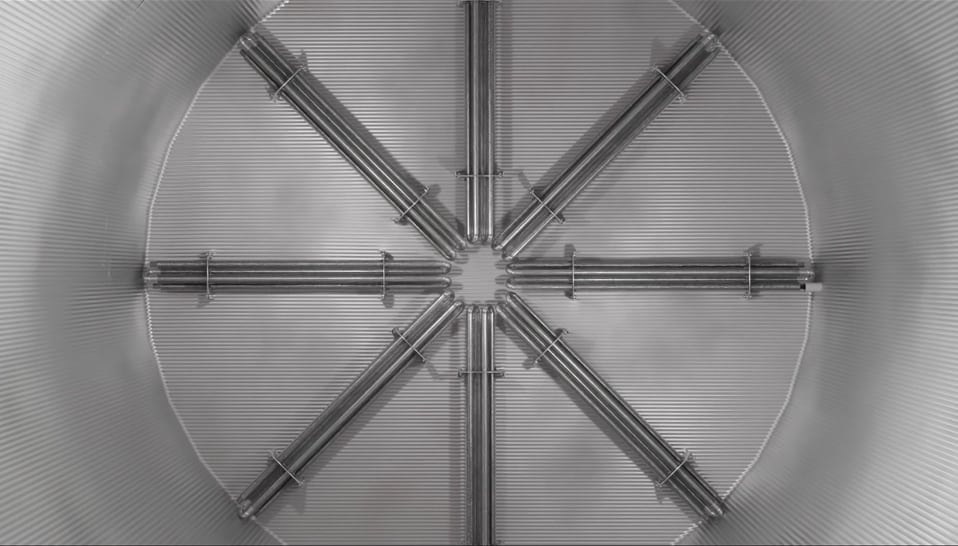
Fin geometry and coil orientation play a critical role in heat transfer efficiency for industrial tank heating and cooling equipment.
Reviewing Replaceable Tank Fins for Industrial Tank Coils
Replaceable tank fins are an alternative fin design sometimes considered for industrial tank coil equipment used in heating and cooling applications. These designs are often presented as a way to increase surface area and simplify maintenance when compared to traditional welded fin tank coils.
This article provides a focused review of replaceable tank fins specifically how they are constructed, what they are intended to accomplish, and how they perform when evaluated against established heat transfer principles. Understanding these factors can help facility managers and engineers determine when replaceable fins may be appropriate and when more proven tank coil designs are better suited for long-term, reliable operation.
What Are Replaceable Tank Fins?
Replaceable tank fins are typically aluminum fins that are mechanically attached to a pipe using bands or fasteners. Their primary purpose is to increase the effective surface area of the pipe, which can improve heat transfer under certain operating conditions. Another commonly cited benefit is the ability to replace individual fins if fouling or coking occurs, rather than replacing the entire coil.
While this approach introduces a different maintenance strategy, overall tank coil performance depends on more than surface area alone. Thermal contact, material compatibility, installation orientation, and flow dynamics all play critical roles in how effectively a tank coil performs in real-world applications.
Key Design Considerations When Evaluating Tank Coils
1. Thermal Bond Between Fin and Pipe
Efficient heat transfer requires a strong, consistent thermal bond between the fin and the pipe. Continuously welded fins provide a permanent connection that allows heat to move efficiently between the pipe and the process fluid.
Mechanically attached fins, by comparison, rely on clamping force to maintain contact. Over time and through repeated thermal cycles, small gaps can develop that reduce heat transfer efficiency.
2. Materials of Construction
Tank coils are commonly manufactured from carbon steel or stainless steel, depending on the process fluid, operating temperatures, and corrosion requirements. For optimal performance, fins and pipes should be made from compatible materials that expand and contract at similar rates when heated or cooled.
Enerquip designs and manufactures tank coils in both carbon steel and stainless steel, allowing material selection to be tailored to the specific application rather than constrained by a single design approach.
3. Installation Orientation Is Critical
The orientation of tank coil equipment has a significant impact on heat transfer performance and fouling tendencies.
-
Horizontally installed tank coils benefit from fin designs that promote continuous fluid movement across the heating or cooling surface. In these applications, helically wound fins are typically preferred.
-
Vertically installed tank coils can be well suited for longitudinally finned designs, where natural convection supports effective heat transfer and minimizes stagnant flow zones.
Longitudinal fins can perform effectively in vertical installations, but they are generally not ideal for horizontal mounting, where stagnant areas between fins may increase fouling risk.
Proven Tank Coil Equipment for Heating and Cooling Applications
Industrial tank coils are used for both heating and cooling, and proven designs have evolved to support reliable performance across a wide range of industries. Continuously welded fin coils, manufactured from carbon steel or stainless steel, remain a trusted choice because they offer:
- Strong, permanent thermal bonds
- Consistent performance across operating temperatures
- Design flexibility for vertical or horizontal installation
- Long service life in demanding industrial environments
Rather than focusing on a single feature, such as fin replaceability, effective tank coil equipment balances material selection, fin design, and installation pattern and orientation with the specific process requirements.
Selecting the Right Tank Coil Equipment
When evaluating tank coil options, it’s important to consider how the equipment will perform over its full service life. While replaceable tank fins may offer an alternative approach, established welded fin designs often provide more consistent heat transfer, reduced fouling risk, and greater long-term reliability.
At Enerquip, we design and manufacture custom tank coil equipment for both heating and cooling applications, with options available in carbon steel and stainless steel. Our coils are engineered to meet specific process requirements and are manufactured in the USA with a focus on performance, durability, and long-term reliability.
If you’re evaluating tank coil designs, our experienced team can help you determine the best solution for your application.
Contact Enerquip to discuss your tank heating or cooling needs.
More from the Enerquip Blog
Key Benefits of Low NOx Thermal Fluid Heaters
Serpentine vs. Helical Coil Heaters: Understanding the Differences
How to Store Your Process Equipment Before Installation
What You Need to Know About Cleaning Different Tube Configurations