
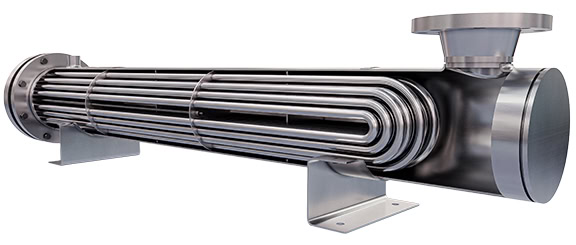
When it comes to shell and tube heat exchangers, consistency, quality, and performance matter. That’s why the Tubular Exchanger Manufacturers Association (TEMA) developed a comprehensive set of industry standards to guide the design and manufacturing of these systems for a wide range of critical applications.
In this article, we’ll break down what the TEMA standards include, what they mean, and how they’re applied.
About TEMA Heat Exchangers
TEMA brings together industry-leading manufacturers of shell and tube heat exchangers. In creating standards, these key players have determined the important features and functionality for these heat exchangers to operate safely in specified applications. Standards also help ensure that quality and performance are consistent across manufacturers. The standards cover things like tolerances, machining operations, and the design of components used in the heat exchanger assembly.
TEMA Heat Exchanger Specifications
First published in 1941, the current version of TEMA shell and tube heat exchanger standards dates to the 2024 update. Today, most shell and tube exchangers used in high-demand industries around the world still follow these established guidelines.
The standards apply to exchangers with:
- Shell diameters up to 60 inches
- Design pressures up to 3,000 psi
- A combined diameter and pressure value not exceeding 60,000 in-lbs
TEMA also provides guidelines for larger units in its documented Recommended Good Practices.
There are three classifications based on intended use:
- Class R: Designed for use in refineries for petroleum processing. These are also often used in large-scale or high-severity industrial applications.
- Class C: Intended for general commercial use.
- Class B: Developed for chemical processing applications. They are usually made from stainless steel or alloys, which allow for slightly lighter construction in non-critical areas.
TEMA Designations for Shell and Tube Heat Exchangers
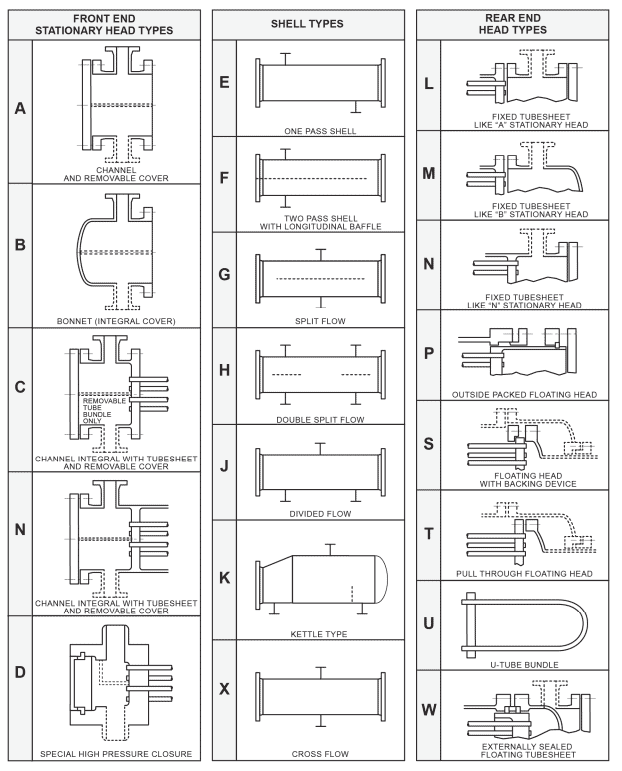
In addition to classifications, TEMA documentation also defines several designated types of heat exchangers, based on the combination of front end, shell, and rear end components used.
These three types of components are:
- Front-End Head: The exchanger’s inlet and outlet channels, types A, B, C, N, and D.
- Shell: The shape and construction of the shell, types E, F, G, H, J, K, and X.
- Rear-End Head: Including tube access and thermal expansion capability, types L, M, N, P, S, T, U, and W.
There are multiple designations, each with a different combination of front-end, shell, and rear-end types. It’s important to note that not all designations may be suitable for each TEMA class: the application and use conditions always govern the design options available.
Source: TEMA
Common TEMA Configurations
Straight Tube with Fixed Tube Sheets
A simple and cost-effective configuration that can be used with single- or multi-pass tube configurations.
- With removable heads – AEL, BEM, AEM
- With non-removable bonnet and removable covers – NEN
Floating Head and Tube Sheet
These designs allow for easy access to the tubes for cleaning, inspection, and maintenance, and also provide thermal expansion protection without need for an expansion joint.
- Removable bundle – AEW, BEW, AES, BES, AET, BET. These designs allow for easy access to the shell side for cleaning/maintenance.
- Non-removable bundle – BEP, AEP, NEP
U-Tube
A type of bundle design with maximum thermal expansion capacity. The tubes expand and contract independently from the shell, and the unit can therefore handle greater thermal shock. Most are removable bundles, which allows for easy replacement in case of a tube failure.
- Removable bundle – BEU, AEU. The BEU configuration is by far the most common.
- Non-removable bundle – NEU, CEU. These are good for high-pressure or harsh process conditions where an all-welded configuration is needed.
Kettle Reboiler
Designed for use in distillation and similar processes. These exchangers vaporize one fluid to heat another, ideal for high-performance chemical and petrochemical processes.
- BKU, AKU, AKT
Shell Designations
Note that most designations above include an E style shell – this is a single pass shell, the most common and versatile design. If the thermal process requires it, most of these could be changed to incorporate other shell configurations:
- F-shell – Two-pass shell
- G/H/J-shell – Split or divided flow
- X-shell – Cross flow
- K-shell – Kettle type for vaporization
Final Thoughts
TEMA standards bring structure to a complex design world—but they don’t tell you which type of exchanger to choose. That’s where a knowledgeable manufacturer comes in.
At Enerquip, we specialize in sanitary and industrial heat exchangers built to TEMA standards. Our in-house team handles design, fabrication, welding, machining, inspection, and testing—from start to finish. With decades of experience, we can help you select and build the right shell and tube heat exchanger for your unique process.
Let’s get started—contact us or request a quote today.
More from the Enerquip Blog
- Vacuum Breakers 101: Small Device, Big Impact on Heat Exchangers
- 5 Smart Maintenance Tips to Keep Your Shell & Tube Heat Exchanger Performing at Its Best
- How Almost Any Industry Can Benefit from Waste Heat Recovery
- What to Know About Clean-in-Place (CIP) Systems
- How Evaporation Equipment Powers Food, Pharma, Energy & More
- Floating Tube Sheet Straight Tube Exchangers – Advantages and Types