
When it comes to keeping your heat exchanger running smoothly, a small device called a vacuum breaker plays a big role. Think of it as a safety valve that prevents your system from turning into a steam-powered implosion.
What Is a Vacuum Breaker?
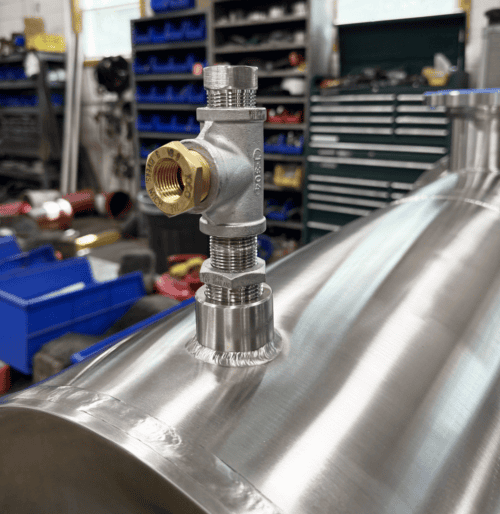
A vacuum breaker is a simple, spring-loaded valve that allows air into a closed system when internal pressure drops below atmospheric pressure. In steam systems, this prevents a vacuum from forming as steam condenses, helping to avoid equipment damage and operational issues.
Why Heat Exchangers Warrant Vacuum Breakers
In a shell and tube heat exchanger, steam condenses inside the shell to transfer heat to the fluid flowing through the tubes. As the steam condenses, it creates a reduction in pressure that can develop into a vacuum. This introduces two types of problems:
Mechanical Risk
If the shell isn’t designed to withstand the pressure differential created by a vacuum, it can collapse, similar to crushing an empty soda can. Vacuum conditions can also contribute to water hammer when steam suddenly rushes back into the exchanger, creating loud noises and potentially damaging the equipment.
Installing a vacuum breaker allows air to enter the shell as pressure drops, preventing a damaging vacuum from forming.
Performance Impact
Even if the heat exchanger is mechanically rated for full vacuum, the process itself may not be intended to operate under vacuum conditions. A vacuum can:
- Alter the thermal or mechanical properties of process fluids.
- Hinder condensate drainage.
- Reduce heat transfer efficiency.
- Cause inconsistent or inefficient system operation.
A properly installed vacuum breaker helps maintain atmospheric pressure inside the shell, allowing the exchanger to operate as intended.
Installing a Vacuum Breaker: Best Practices
Proper installation is essential for reliable operation.
Location: Install the vacuum breaker at the top of the heat exchanger shell or on the steam supply line near the exchanger. This allows air to enter at the point where the vacuum develops.
Orientation: Mount the vacuum breaker vertically with the cap facing upward to ensure proper operation.
Isolation Valve: Install an isolation valve below the vacuum breaker to simplify maintenance without shutting down the entire system.
Maintenance: Periodically inspect the vacuum breaker for debris, corrosion, or wear. While many models are not repairable, routine inspections can help prevent unexpected failures.
Vacuum Breakers on Enerquip Shell & Tube Heat Exchangers
Our standard shell and tube heat exchangers, are engineered to withstand full vacuum conditions. That means they do not require a vacuum breaker strictly for mechanical protection.
However, larger or custom-designed exchangers may not be vacuum rated by default. Vacuum-rated construction often requires thicker materials, which can significantly increase manufacturing costs. For these units, we perform vacuum calculations only when requested during the design process.
From a performance standpoint, though, even a structurally robust heat exchanger may still benefit from a vacuum breaker or pressure relief device installed on the exchanger or within the process piping. That’s why nearly every Enerquip exchanger includes a vent connection on the shell, giving you the flexibility to install a vacuum breaker whenever your application requires one.
Vacuum Breaker Kit
For applications that require a vacuum breaker, Enerquip offers a convenient kit that includes the components needed for installation.
The kit includes the following components (shown left to right):
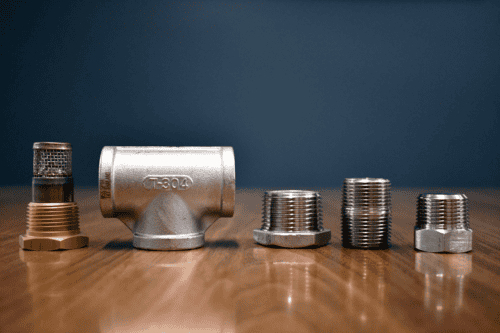
Kadant Johnson Vacuum Breaker
- Connection: ¾” NPT male × ½” outlet
- Function: Admits air into the system when a vacuum develops, preventing vessel or piping collapse and helping reduce the risk of water hammer.
Stainless Steel Threaded Tee
- Size: ¾” NPT female
- Function: Provides a branch connection for mounting the vacuum breaker while remaining inline with the process connection.
Threaded Reducer Bushing
- Size: 1″ NPT male × ¾” NPT female
- Function: Adapts a 1″ process connection down to the ¾” tee.
Close Pipe Nipple
- Size: ¾” NPT male × ¾” NPT male
- Function: Connects the tee to the reducer bushing while minimizing added installation length.
Hex Head Pipe Plug
- Size: ¾” NPT
- Function: Seals the unused branch of the tee while maintaining the proper configuration for the vacuum breaker assembly.
Bottom Line
A vacuum breaker is a small, inexpensive component that can help protect your heat exchanger from vacuum-related damage while improving overall system performance. Whether you’re preventing vessel collapse, minimizing water hammer, or maintaining proper condensate drainage, installing the right vacuum breaker in the correct location can reduce downtime and extend equipment life.
Not sure if your heat exchanger needs a vacuum breaker? Contact the Enerquip team for application guidance, recommended part numbers, or to order a complete vacuum breaker kit. We’ll help you select the right components to keep your system operating safely and efficiently.